Being a Breakfast Radio Host Part 2

I found the secret to a good radio show is the preparation – three hours is a long time to fill with inane natter. So during the week I carry around a notebook and write down ideas for things we can talk about.  Topics people can relate to and share their own anecdotes are the best ones. Also anything topical makes for a good segment so keeping an eye on the news and blogs pays off in making interesting content. Our most popular segment was the one talking about Melbourne becoming the world’s most liveable city. It is a truth universally acknowledged that Melbournians love talking about Melbourne, or anything to do with Melbourne really.

The Monday’s team with Paul Harris, director of the St. Kilda Film Festival

One of the interesting/funny parts of radio is the text-in line. We have a number that we make sure to spruik, and when people text in it appears on the computer screen. It’s the interactive part of the show and can spark up interesting, on-air debates. But sometimes the text in line can go a little wrong. Or maybe a few of the listeners are simply slightly too eager. Either way you want to describe it there are “serial” text-ins you will text every show up to twenty texts a show and it can get a little creepy when they start sharing too many personal details. It can be a difficult situation because on one hand you don’t want to encourage the behaviour if the person is becoming unhealthily obsessed, but it can also be inappropriate and eventually it crosses the line. We had this one text in who shared many a sad detail with us and it was a bit of an injoke, presenters would laugh and roll their eyes, oh yeah he texted in again today and told us this. But then one of the presenters found out who he was and that he was really this lonely IT worker whose favourite thing in life was texting into the station. There was mixed reactions in this, but I think the lesson is to remember that the texters are real people out there listening (just like they should remember that the hosts are real people!) If a texter responds quite negatively to a comment or discussion you’ve made it can be tempting to lash back, but as a host it’s really your responsibility to put your “tough skin” on and remain in control by not letting it affect you so you can best do your job – which is to provide positive entertainment to the rest of your listeners!

Dead air is a scary thing. Seconds of silence feel like hours of silence. Talking when you’re not quite sure of where your sentence is going is something I have to do a lot and it’s a bit of a skill to develop an articulate way of talking on radio. One of the tricks I’ve discovered is to slow down what you’re saying so there’s more time to think about what you’re going to say next. Also having an idea of the beginning, middle and end of your story is definitely something to keep in your mind so you don’t get side-tracked with confusing tangents.

I’ve really appreciated getting more experience in interviewing. We usually do two interviews a show, an ‘Arts’ interview and a ‘Music Interview.’ The producer helps out with this by doing the background research, writing an introduction, checking all the facts and writing five suggested questions, but we’re highly encouraged to do our own research and questions too. So far on the show (which is five weeks in) we’ve interviewed a comedy duo, a Major from the Salvation Army, the director of the St. Kilda Film Festival, one of the guys running the Live Below the Line campaign, and up and coming bands such as Immigrant Union, Tin Sparrow and Damn Terran.

Find this fascinating? Read about some of the challenges of radio in Part 3

You can download a podcast from our show here!
Being a Breakfast Radio Host Part 1

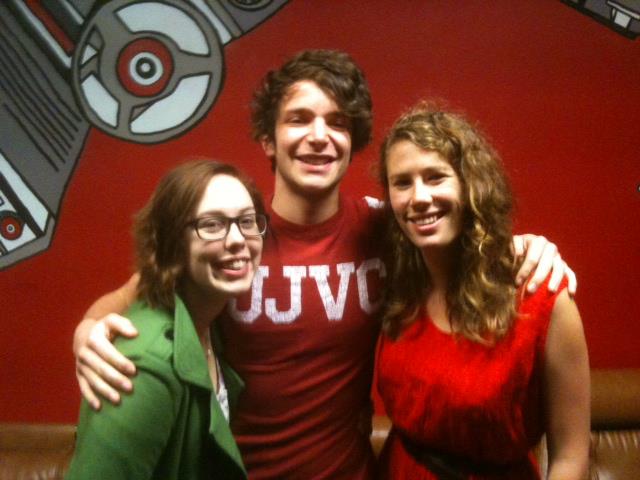
The Monday Get Cereal Team: Erin, Mark and Rachel

What’s the most fun you can have at 6am in the morning? Breakfast radio! I applied to be on the SYN flagship show ‘Get Cereal’ because (and this will sound cheesy) but I always wanted to have my own radio show. My little brother and I used to tape ourselves making up our own show, singing jingles and putting on voices for the different characters. Radio is a place where talking and feeling no shame are skills required for creating entertainment, and it’s incredible to think that as a breakfast host you are speaking right into people’s bedrooms and cars, cheering up their morning.

So the 4.30am wakeup in order to get ready and travel into the SYN studios at RMIT aren’t too bad. I was thought it would be a struggle at first, but it’s amazing what you’re capable of when you put your mind to it. I’ve learnt about the team behind a good breakfast radio show, it’s not just the hosts with the personality bouncing off the walls and each other. There’s a talks manager who organises the interviews for the shows and sends out the brief, a (mostly) silent producer who sits in the studio with you and will signal to you when you should wrap up or extend your “talk break”. He has the ability to step away from the immediacy of what you’re talking about to the show’s success as a whole, so it’s a vital role and someone worth listening to. He can also tell you the passwords to the studio when you get locked out in the freezing pre-dawn cold. He’s not the only producer – the overall guidance for the show comes from the Executive Producer, a girl with superhuman ability for enthusiasm in the wee hours.

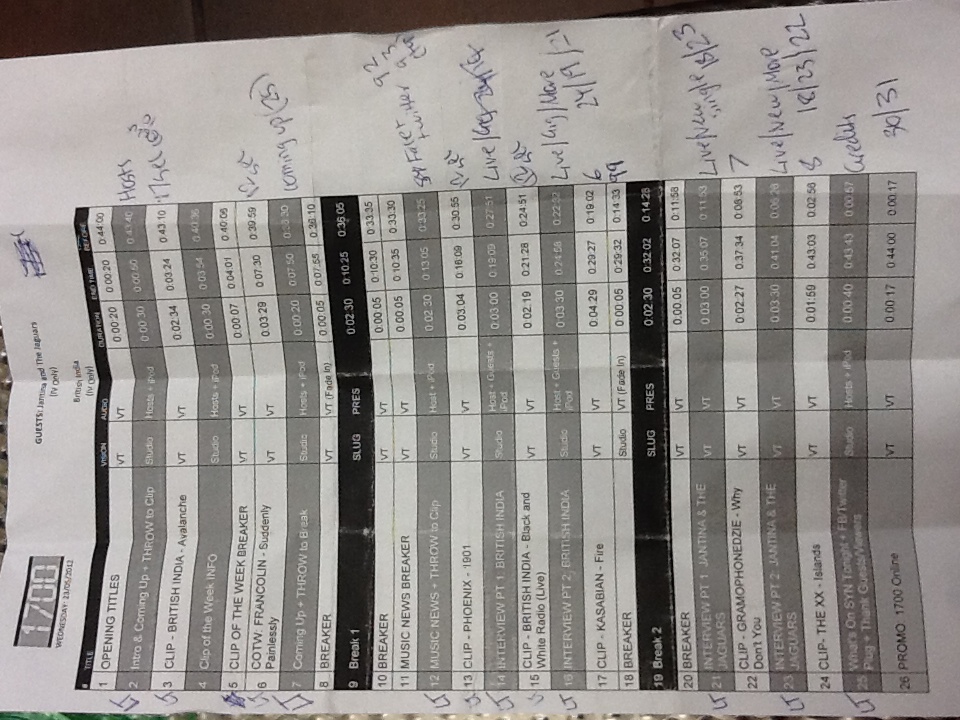
Together they figure out the structure of the show, with the producer writing out a run sheet which lays out how the morning will run. From 6-7am we keep it light, play a of music and warm up out talk breaks, from 7-8am we do more talk breaks, our producer has a segment , “Getting Nerdy with Dave” where we chat about “nerdy” things, we do our own segment called, “The good, the bad and the covers” where we play a good cover, a bad cover and a wild card cover (this is especially effective in eliciting response from our audience – especially when we did a segment about ‘Smells like Teen Spirit’ covers which included Miley Cyrus, Tori Amos and the Muppets), we also do a phone interview with a regular contributor representing the SYN TV show 1700. From 8-9am it’s our “Aussie Music Hour” so we swap our cds that we’re playing from to one that includes only Australian made music. This is the more “prime time” hour with the most listeners, so it includes our interviews. We usually have one “Arts” interview, which can include anyone from The Pajama Men (a comedy duo) to the director of the St. Kilda Film Festival and a music interview. If we’re lucky the interviews are done in the studio (as opposed to the phone, which isn’t as fun and the interview isn’t as interesting), and if we’re really lucky the band will even perform live in the studio, all we have to do is place the mikes and feel quiet.

Read Part 2 for more in depth discussion about the finer details of a breakfast host’s life…and/or watch this behind the scenes video:

Reflecting on Live TV Graphics

REFLECTIONS ON RUNNING A GRAPHICS PROGRAM FOR LIVE TELEVISION

It had never crossed my mind to consider how tv shows got their boxes of text flashing on the lower half of their programs, it always so seamless. Well Now I know exactly how it feels to be the person operating the graphics, it’s a flurry of typing, dragging and clicking timed to the very last nano second. It’s one of those jobs that no one notices when it’s going well, but is glaring obvious when you muck it up – mistype something, or load the wrong music video.

I was able to shadow previous graphics operator for one of the shows and through close observation was able to suggest a few things to help her. She was quite young and had a bit of “superstitious” thinking – not thinking through the reasons that something may work or not work, but claiming things without questioning it. But it meant that if something went wrong she wasn’t able to fix it and would often freak out and freeze on the job. I never thought I was particularly good at technology but I convinced the producer I was a “technical whiz” just by realising that you can work out most things by logically thinking about it (which kind of excited me).

So it’s fast paced and you have to make decisions in split seconds so you always have to think ahead, but that makes the hour long show fly fast (you don’t see much, but you can always catch up later with the podcast, such as the one here which you can see for yourself…)

KEY SKILLS

  •   Basic photoshop skills
  •   Operating a graphics
  •   Prioritizing many competing tasks that require immediate attention
  •   Following technical directions
  •   IT Problem solving
  •   Working to a precisely timed schedule
  •   Keeping a cool head under pressured situations.
  •   Attention to detail
  • Following a run sheet. Like this one:
  •   

Reflections on Crewing at 1700

REFLECTION ON CREWING AT 1700

On my first day of placement at SYN, I was sent straight to the Channel 31 studios, was introduced to the team made up of an executive producer, producer, two hosts and several other bodies to fulfil the rest of the crew – a director, audio guy, graphics operator, vision switcher, floor manager and the camera operators. Before this day I had no idea what roles were required to produce an hour long tv show, but this was precisely why I opted to do my placement at SYN: to gain an insight to the mediums of radio and television. As a music student it seemed important to me (and interesting) to learn hands on about the mediums through which most people experience music, to be able to imagine ways to contextualising great content in a form accessible to people of all walks of life.

After using the brawn I had to help put together the sets, I was told I would be operating the cameras for the show. The floor manager for the day gave me brief run down on how to operate the expensive looking equipment on wheels (a dolly) and before I could reflect on my lack of experience, we were live, on air, and every time the red light glowed on my camera it meant that it was through my lens the thousands of people watching were viewing the action. It was fun, I liked being able to frame interesting and good looking shots – compensating for the height difference between the hosts, filming the instruments of the band who were performing live In the studio, following the director’s feedback through my headphones to reduce the “head space” and a get a “mid shot.”

The next week I graduated to floor manager, which meant teaching the other new camera operators how to focus their lens and line up their shots (that’s how SYN works, you learn quickly on the job, and in no time you’re showing others the ropes). I had the additional responsibility of counting down to when the show would be live with the code of hand signals.

It’s a role that is primarily based on effectively carrying out orders to produce another’s artistic vision but that doesn’t mean that there isn’t room for some creative intuition as well, as the director doesn’t spell out every shot that you should do. So you need to be on your toes, making sure your lenses are focused and being aware of how the scene is changing.

KEY SKILLS

  •   Clearly communicating directions from director to others.
  •   Camera operation skills: framing effective shots
  •   Learning quickly on the job and under pressure
  •   Teamwork: ensuring knows what their role is and is empowered to carry it out
  •   Eye for detail, knowing when to use one’s intuition