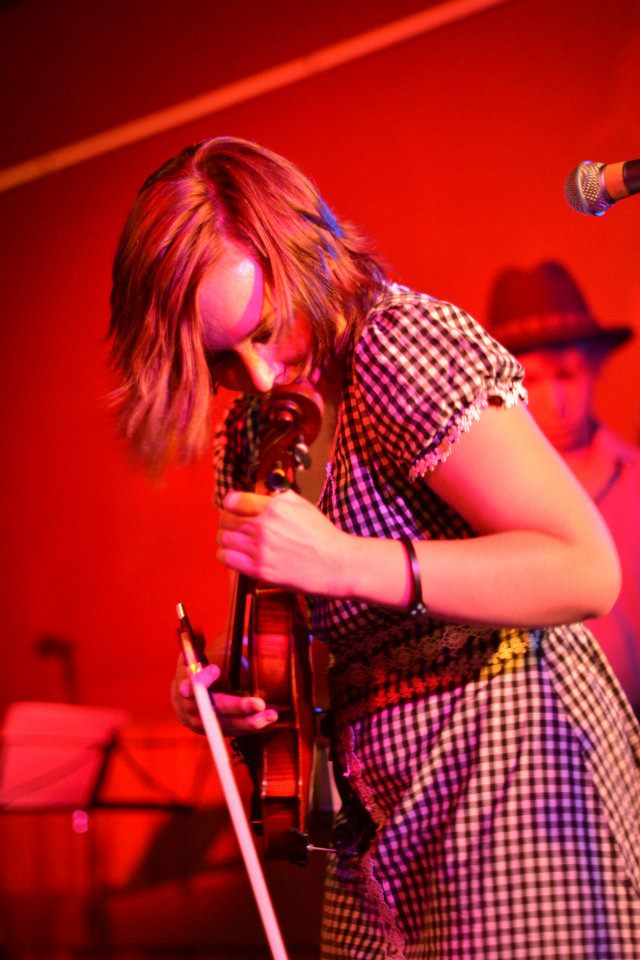
 You play a piece. Note for note accurately playing exactly what’s on the page. Recreating notes penned hundreds of years ago.
You play a piece. You linger a little on the last note. You add in a few notes to embellish the turnaround. You decide you want the middle section to sound more like a dance so rearrange the accents to a 5/4 feel. Because you’re playing this piece without its usual piano accompaniment you underscore the melody with some double stops to create a more complex harmony. The recapitulation sounds a little boring to you so you take the main idea of the melody and start to improvise on it, starting simply and evolving it to something completely original to finish the piece off. Mozart penned these notes hundreds of years ago but now it’s been infused with your context, your personality, your own sound.
What is “creative strings” or “alternative strings”?
It’s the idea of turning away from what’s written on the page. It’s turning away from a formal mindset bent on nothing but accuracy and moving towards a more creative attitude of playing music. This is not to say less talented, less accurate, sloppy playing. Thought and musicality must go hand in hand.
Creative strings involves composing, arranging, improvising and collaborating with other musicians or artists in other medium (video artists, dancers, actors). It’s taking our various string instruments out of their boxes and claiming their artistic merits as not just a cog in the orchestra machine or for only the privileged few with enough training and opportunity to play traditional concertos. It’s claiming the violin as your own individual voice no matter what level of skill you’re up to.
It’s about engaging with the music of your culture. It’s about engaging in the music of other cultures. It’s widening our scope of what we listen to, of what we think we can perform and create, of how we think about music.
It’s knowing how to approach any musical situation you come across – not just situations where there happens to be sheet music to follow!
Is there such thing as contemporary violin? What would this look like? What would whole communities of contemporary violinists offer to the world? Where are the jam circles, forums, the sharing of transcriptions and passionate engagement with music?
Most traditional pedagogy is focused around the goal of training for an exam. Which I really liked to do but I also liked to improvise, play in rock bands, listen to world music, learn fiddle tunes from around the world and create my own music. But these were all things I worked out for myself and felt a bit of a loner in – I didn’t feel there was a string community that was supportive of my goals beyond win this audition, ace this exam. In fact that often screwed up their noses when I would add in a slide, or say I enjoyed playing gypsy music or played in a folk rock band.
It could be a pedagogy about not just playing this note and play it right, but exploring your instrument and music as a whole. Perhaps this would excite more people to take up an instrument and continue playing beyond high school.
So it’s my mission to both become a complete musician, with good technique on my instrument used as a tool box for further creative expression and to teach others to do the same.
Don’t freak out if classical music is all you’ve known. Let’s keep doing our Kreutzer studies but also study the most common chord progressions so we can participate in a jam session. I don’t think participating in the creative side of music will detract from playing our concertos but rather improve it. Since I’ve been delving into some harmonic study, sight reading orchestra repertoire has become easier as I can see the patterns of the way the music is constructed. My pieces take on freshness as I approach them. And it saves me when I’m playing a wedding gig and run out of repertoire, so I improvise on some Disney ballads (which get the biggest reaction of the whole set). Again I say – let’s take away the limits!
I am not advocating dismissing traditional pedagogy entirely but rather opening it out. I think this will get more people interested in playing string instruments – they will feel like they can create meaningful music even if they haven’t been playing since they were six. Creating more meaningful music at all stages of learning an instrument.
The way I see it is that immortality as a musician is in both creating new music and teaching others.
GREAT LINKS FOR FURTHER DISCUSSION ON THE IDEA OF CREATIVE/ALTERNATIVE STRINGS
- Christian Howes is a giant among contemporary jazz violin, especially in creative strings pedagogy. In fact he has created the ‘Creative Strings Academy‘ where you can sign up for with videos, books and instruction that guides you along the process (first month is free so nothing to lose in having a look – I’ve certainly learnt a lot!) The blog is also excellent with many ideas on how to start flexing your creative muscle in string playing.
- Mark O’Connor has developed an entire method incorporating folk and improvisation into beginner violin pedagogy. He talks of a past where the violin-composer was at the forefront of contemporary music and laments the current state in ‘How Violinists Got Less Creative’
- A group of guys in Los Angeles have put together ‘String Project’ have built classes focusing on whatever style kids want to learn and create in from Beatles to hip hop. Very cool!
- On the board of the International Society for Improvised Music, La Donna Smith has a lengthy but interesting article about how we need creativity in music education, especially with its power to cross cultural boundaries.
 Erin Lancaster